
BIO Plug™
A biodegradable punctal plug made from polydioxanone (PDO), designed to reduce tear outflow and help maintain tears on the ocular surface.
A biodegradable punctal plug made from polydioxanone (PDO), designed to reduce tear outflow and help maintain tears on the ocular surface.
Products > BIO OPTICS > BIO Plug™
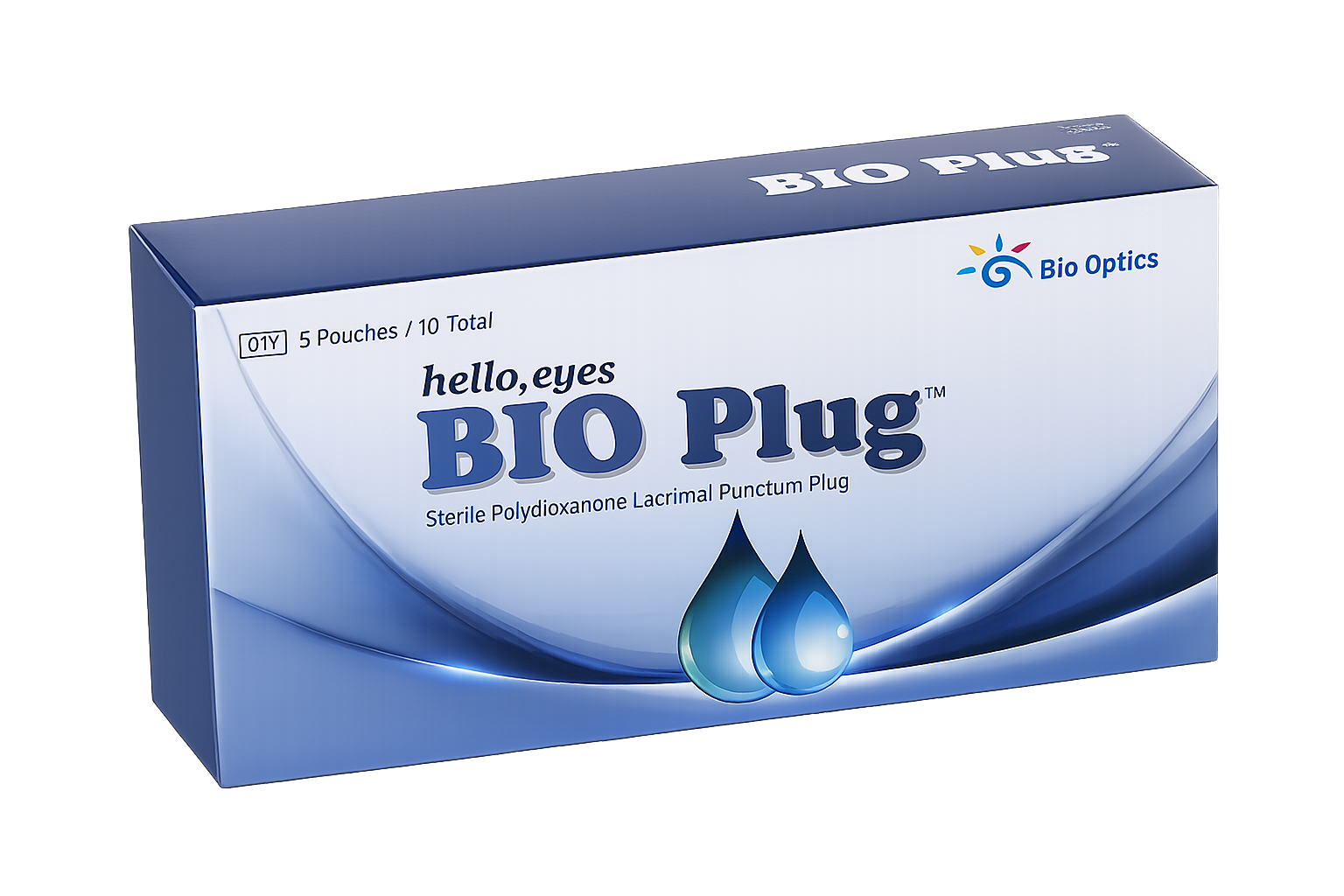
BIO Plug™ is inserted into the tear duct through the punctal opening using medical forceps, thereby reducing tear outflow and assisting in maintaining tears within the eye. It is suitable for patients with dry eye, and its effect can last for approximately 180 days after insertion.
The standout feature of BIO Plug™ is its biodegradability, which eliminates the need for a separate removal procedure. Polydioxanone (PDO), the material used in the plug, gradually biodegrades after insertion and fully dissolves within approximately 180 days.
The PDO material gradually dissolves after insertion, avoiding the need for plug removal.
Made from absorbable polydioxanone material with a violet color for visibility during placement.
Designed to remain effective while gradually biodegrading over approximately six months.
Unlike permanent silicone plugs, the absorbable PDO design gradually dissolves, reducing prolonged foreign-body exposure that may contribute to biofilm formation.
Designed for patient comfort when correctly positioned in the punctum.
Three diameter options are available to support appropriate punctal sizing.
Compared with permanent silicone punctal plugs, absorbable plugs offer a temporary, procedure-friendly option for tear conservation without requiring long-term retention of a permanent implant.
| BIO Plug™ — Dissolvable Lacrimal Punctum Plug | |
|---|---|
| Product Details | |
| Material | Polydioxanone (PDO) |
| Color | Violet |
| Absorption period | Approximately 180 days |
| Available diameters | 0.3 mm, 0.4 mm and 0.5 mm |
| Box configuration | 5 pouches per box |
| Pouch configuration | 2 plugs per pouch |
| Model No. | Length (mm) (±0.1 mm) |
Diameter (mm) Metric Size Standard: EP (USP) |
|---|---|---|
| BIO Plug 0.3 | 2.0 | 0.340–0.399 (2-0) |
| BIO Plug 0.4 | 2.0 | 0.400–0.499 (0) |
| BIO Plug 0.5 | 2.0 | 0.500–0.570 (1) |
Clinical applications
Supports tear retention by reducing drainage through the punctum.
May be used as part of postoperative dry-eye management after refractive procedures.
Supports patients experiencing ocular surface dryness associated with contact lens use.
May support postoperative tear-film management following cataract surgery.
May help conserve the natural tear film in appropriately selected patients with keratoconjunctivitis sicca.